
 en
en
Information protection accompanying every step of life
Follow OHMIEX Intelligence for more valuable information to know early
Follow OHMIEX Intelligence for more valuable information to know early
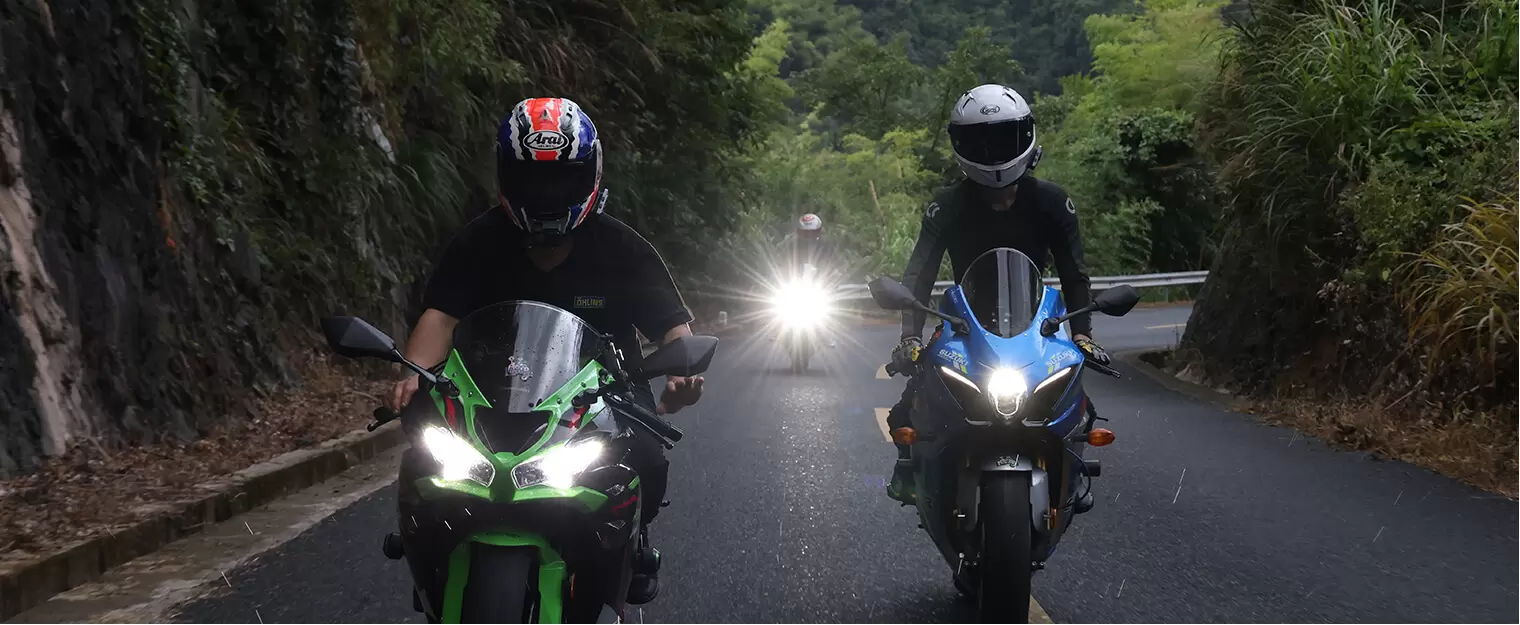
Autumn riding conditions across Europe and North America can change quickly, with cooler wind, occasional light rain, wet roads, and significant differences between urban, highway, mountain, and open-road environments. For motorcycle gear dealers, these conditions can also expose weaknesses that may not be obvious when products are evaluated only from specification sheets.
Wind noise, communication stability, battery endurance, and water resistance can all affect the actual user experience. As a result, choosing a motorcycle intercom should involve more than comparing Bluetooth versions, advertised range, or battery capacity.
For dealers and distributors, the more important question is:
How will the product perform when customers actually take it onto the road?

Motorcycle intercoms operate in an environment that is considerably more demanding than stationary Bluetooth applications.
During an autumn ride, a headset may encounter changing wind speeds, traffic density, road obstacles, light rain, water splash, and changes in terrain within a single trip. These conditions can influence communication quality and effective wireless distance.
The same motorcycle intercom can therefore produce different results in:
Highways
Urban roads
Mountain roads
Open coastal areas
Dense traffic
Different riding speeds
Different weather conditions
This is particularly relevant for dealers because customer expectations are often based on product specifications. If the customer's actual riding environment differs significantly from the conditions behind a quoted parameter, the resulting gap can lead to complaints or unnecessary returns.
Rather than presenting communication range or battery figures as universal results, OHMIEX evaluates its products through outdoor road testing.
Testing has covered highways, urban roads, mountain roads, and open environments, with attention to communication distance, riding speed, battery endurance, group communication, and actual wearing experience.
The OHMIEX C1 is positioned for daily commuting and two-rider communication.
During testing:
Intercom battery endurance: approximately 39 hours
Intercom + music: approximately 24 hours
Measured communication distance: approximately 600 m
Highest tested riding speed: 100 km/h
Voice communication: good clarity under the tested conditions
Continuous wearing test: approximately 1–2 hours
The C1's official specifications include Bluetooth 5.3, two-rider intercom communication, a 40 mm speaker, IPX5 water resistance, and a 1050 mAh battery. Its product design also includes glove-friendly physical controls and clip-on installation.
The OHMIEX D9 is designed for riders requiring multi-rider communication and group touring functions.
During testing:
Tested group communication: 4–6 riders
Maximum connected devices in testing: 6
Measured communication distance: approximately 1.5 km
Open coastal environment: tested at riding speeds up to 160 km/h
Road testing: highway, urban, mountain, and open-road conditions
The D9's official product information includes Bluetooth 5.4, six-way intercom capability, IPX7 water resistance, ENC noise reduction, a 1000 mAh battery, and smart connectivity functions.
Communication distance and battery endurance should always be interpreted in relation to the testing environment.
OHMIEX's road tests demonstrate how significantly conditions can affect wireless communication. For example, the D9 achieved an effective distance of approximately 700 m in a highway environment in the Philippines with dense motorcycle traffic, while testing in an Indonesian road environment achieved approximately 1.5 km under the applicable conditions.
These differences are expected because communication can be affected by:
Traffic density
Buildings and other structures
Terrain
Trees and other obstacles
Rider positioning
Riding speed
Electromagnetic interference
Weather conditions
Helmet configuration
Device placement
The same principle applies to wind noise and voice clarity. Performance can change with riding speed, wind direction, helmet design, microphone positioning, and the surrounding environment.
Therefore, the test figures in this article should be treated as reference results from specific outdoor testing conditions, rather than guaranteed performance for every market or riding scenario.
This approach allows dealers to communicate product capabilities more accurately and helps reduce unrealistic customer expectations.
Not every motorcycle rider requires the same communication solution. For dealers, product segmentation can make product recommendations clearer and reduce mismatches between customer requirements and product capabilities.
| Customer / Riding Scenario | Recommended Model | Main Product Focus |
|---|---|---|
| Daily commuting | OHMIEX C1 | Simple operation and practical communication |
| Couple / two-rider trips | OHMIEX C1 | Two-rider intercom |
| Short weekend rides | OHMIEX C1 | Communication, music, battery endurance |
| Food delivery / frequent urban riding | OHMIEX C1 | Daily-use functionality |
| Motorcycle clubs | OHMIEX D9 | Multi-rider communication |
| Group touring | OHMIEX D9 | 4–6 rider communication |
| Long-distance group rides | OHMIEX D9 | Group connectivity and extended use |
| Mixed-brand riding groups | OHMIEX D9 | Cross-brand communication capability |
The purpose of this segmentation is not to define one model as universally better than the other.
Instead, it gives dealers a practical framework for matching product capability with customer application.
For dealers serving daily riders and couples, the C1 provides a relatively focused product proposition.
Its two-rider communication capability, physical controls, long battery endurance, IPX5 water resistance, and wind-noise optimization address common requirements in commuting and short-distance riding.
The C1 is particularly suitable when customers prioritize:
Two-rider communication
Straightforward operation
Long operating time
Music and intercom use
Everyday weather protection
Compatibility with different riding environments
The product is also designed with interchangeable microphone options and a universal clip-on mounting system, allowing it to be adapted to different helmet applications.
For a retailer, this creates a clear positioning strategy: C1 is a practical communication solution for customers who primarily ride alone or with one partner.
The D9 addresses a different requirement.
When riders travel in groups, communication becomes more complex. The number of connected riders, communication distance, connection management, and compatibility can become more important than simple two-rider operation.
The D9 supports multi-rider communication and was tested with 4–6 riders and up to six connected devices.
Its product configuration also includes Bluetooth 5.4, six-way intercom capability, IPX7 water resistance, ENC noise reduction, voice control, and APP-related functions.
This makes the D9 a more suitable option for:
Group touring
Motorcycle clubs
Long-distance riding
Multi-rider trips
Weekend group rides
Riders requiring broader connectivity
For dealers, the product positioning is straightforward:
C1 focuses on two-rider and daily-use applications, while D9 focuses on multi-rider and group communication.
Product specifications are important for procurement, but they are only one part of product evaluation.
For a dealer, the commercial consequences of an unsuitable product can extend beyond the original sale.
A mismatch may result in:
Customer complaints
Product returns
Replacement requests
Additional technical support
Negative product reviews
Higher after-sales workload
Reduced customer confidence
This is why realistic product positioning matters.
If a customer understands that communication distance depends on the road environment, traffic, terrain, and obstacles, they are more likely to evaluate the product according to its intended application.
Similarly, if a dealer recommends a two-rider product to a couple instead of an unnecessarily complex group communication system, the customer receives a solution that better matches the actual requirement.
For distributors, this creates a more sustainable product-sales model:
right customer → right application → right product → more realistic expectations.
OHMIEX also works with partners looking beyond standard product distribution.
As a professional smart helmet Bluetooth headset supplier, OHMIEX supports OEM and ODM cooperation for companies developing their own motorcycle communication product portfolios.
This provides opportunities for:
Motorcycle accessory brands
Helmet brands
Motorcycle equipment distributors
Regional wholesalers
Motorcycle retail chains
E-commerce businesses
Established riding gear companies
OEM/ODM cooperation can be considered when a partner requires customized branding, product positioning, packaging, configuration, or a dedicated product solution for a specific market.
For distributors, this means OHMIEX can serve not only as a product supplier but also as a long-term development partner for motorcycle communication products.
Learn more about OHMIEX OEM/ODM cooperation
Autumn riding conditions highlight an important issue in motorcycle communication products: product performance needs to be considered in the context of actual use.
Wind, rain, traffic, terrain, riding speed, and group size can all influence the rider's experience.
For dealers, the solution is not simply to select the headset with the largest number on the specification sheet.
A better approach is to evaluate:
Who will use the product?
How many riders need to communicate?
What type of roads will they ride on?
What environmental conditions are common in the target market?
What level of communication and connectivity does the customer actually require?
Can the supplier provide realistic test information and reliable after-sales support?
OHMIEX's C1 and D9 provide two differentiated product directions, allowing dealers to build a more targeted motorcycle intercom portfolio.
The C1 addresses daily commuting and two-rider applications, while the D9 targets multi-rider communication and group touring.
For motorcycle dealers and distributors, selecting an intercom is not only a technical purchasing decision. It is also a product-positioning decision.
A successful product needs to match the riding conditions, customer expectations, and application scenarios of the target market.
OHMIEX combines product development, real-world road testing, and OEM/ODM cooperation to support partners looking to expand or develop motorcycle Bluetooth intercom products.
Whether you are sourcing motorcycle communication headsets for distribution, adding a new product category to your motorcycle accessory portfolio, or developing a private-label intercom solution, OHMIEX can work with you to evaluate the appropriate product direction.
Contact OHMIEX to discuss your distribution, OEM, or ODM requirements and develop a motorcycle intercom solution suited to your market.
All test results presented in this article, including communication distance, battery endurance, riding speed, and group communication performance, were obtained under specific outdoor testing conditions. Actual performance may vary depending on traffic density, buildings, terrain, obstacles, weather, riding speed, helmet configuration, device positioning, electromagnetic interference, and other environmental factors. The data is provided for product evaluation and reference purposes and does not constitute a performance guarantee for every riding environment.


 Email
Email WhatsApp